Table of Contents
- Is Roadside Assistance Available 24/7 in Airdrie?
- Emergency Roadside Assistance: What’s Covered Around the Clock
- Roadside Assistance Response Time: What Affects Your ETA
- What to Do While Waiting for Roadside Assistance
- How to Request a Tow Truck (and What to Have Ready)
- Membership vs. On-Demand: Choosing Your 24/7 Coverage
- Coverage Boundaries and Service Eligibility in Airdrie
- Conclusion
- Frequently Asked Questions
Last Updated: October 14, 2026
Is Roadside Assistance Available 24/7 in Airdrie?
Yes. Roadside assistance Airdrie drivers can count on is available 24/7, including weekends and holidays, a dead battery at 2 AM gets the same response as a flat tire at noon.
But “24/7” is a promise about hours, not speed. How fast someone reaches you depends on weather, traffic, and where you’re stranded, and Alberta’s winters make that urgent: a breakdown on Highway 2 in January is a different problem than one in July.
Roadside assistance Airdrie drivers call for covers far more than towing. Most calls are simpler than people expect.
Emergency Roadside Assistance: What’s Covered Around the Clock
Emergency roadside assistance is on-demand help for a vehicle that can’t be driven safely, from a dead battery to a ditch recovery. In Airdrie these services run around the clock, so the time of day doesn’t change whether you can get help, only the type of call does. A lockout takes minutes; a winch-out from a snow-filled ditch takes longer and needs different equipment.
Here’s what typically falls under 24-hour roadside help:
- Towing and recovery for vehicles that won’t move
- Jump-starts for dead batteries
- Tire changes for flats
Not every provider handles every job. Ask before you commit.
The “24/7” label only tells you the phone line is open. Confirm which services are covered at night, because some providers run towing around the clock but limit fuel delivery or lockouts to daytime hours.
Towing, Recovery, and Winch-Outs
Towing moves a vehicle that can’t be driven; recovery pulls one that’s stuck or off the road; winch-outs handle the ditch and snowbank cases Airdrie winters create.
Flatbed towing is safer for all-wheel-drive vehicles and anything with low ground clearance. Light-duty trucks handle most cars and SUVs; heavy-duty trucks are for larger vehicles and commercial units. If you’re stuck in snow or mud, say so when you call, recovery needs different gear, and the dispatcher must send the right truck the first time.
Batteries, Tires, Lockouts, and Fuel
These four calls make up most of what happens on the roadside, and each has a different fix time.
A jump-start gets you moving if the battery is low but still alive; one that won’t hold a charge needs replacement, and not every provider carries stock at night. A flat tire can be swapped for your spare if you have one and it’s inflated, no spare means a tow.
Roadside Assistance Response Time: What Affects Your ETA
Response time is the gap between your call and the truck arriving. In Airdrie, a realistic estimate ranges from 30 minutes in good conditions to well over an hour during a winter storm or highway backup.
Several things push that number up or down:
- Your location: a driveway in town is faster than a shoulder on Highway 2
- Weather: snow, ice, and freezing rain slow every truck
- Time of day: rush hour adds time even on a short run
Ask for a clear ETA and a callback number. A provider that gives a real window, not a vague “soon,” tells you how they operate.
A quoted 30-minute arrival is an estimate, not a guarantee. In a heavy snow event, that same call can take two hours. Build a buffer if you have somewhere to be, and don’t wait in an unsafe spot just because the clock says help is close.
What to Do While Waiting for Roadside Assistance
Waiting safely matters more than waiting comfortably. Move to the safest available spot, stay visible, and stay warm without running the engine in an enclosed space.
- Pull as far off the road as you can, ideally onto a shoulder or into a lot
- Turn on your hazard lights and set up a warning triangle or flares if you have them
- Stay inside the vehicle unless it’s unsafe, and keep your seatbelt on near traffic
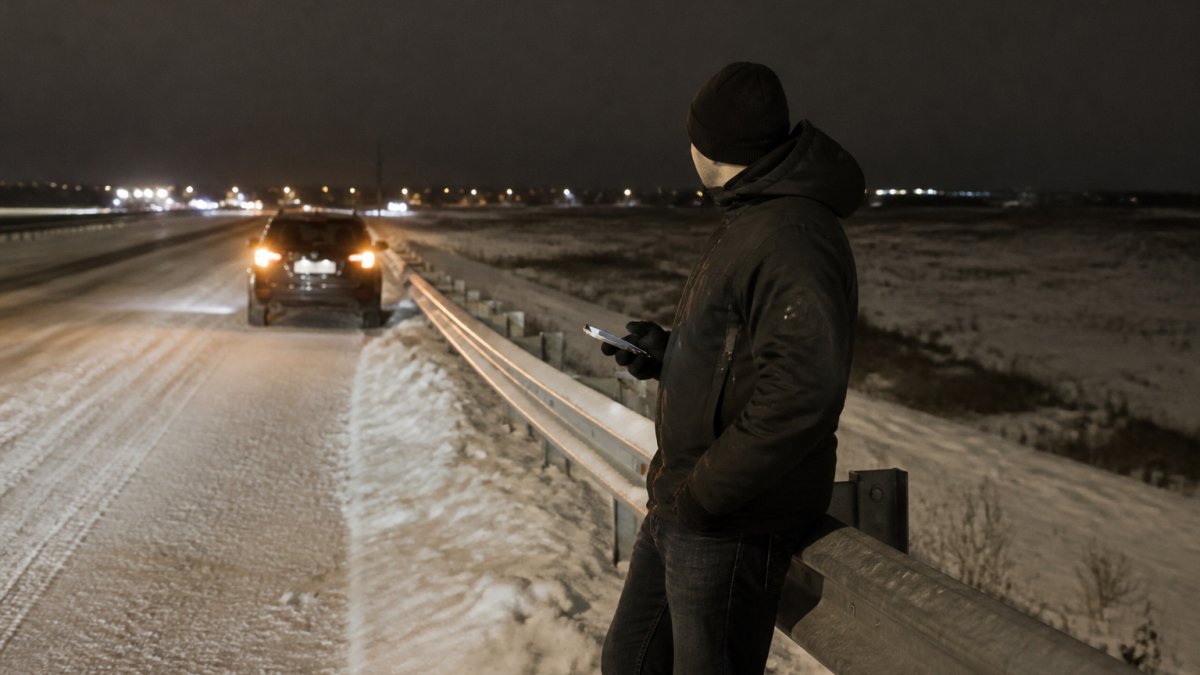
If you must exit, stand behind a barrier, never in the lane. Cold is the other risk: run the heater in short bursts if the engine starts, but never in a closed garage.
How to Request a Tow Truck (and What to Have Ready)
Requesting a tow truck takes one call, but the details you give decide how fast and how well it goes. Have your location, vehicle details, and the problem ready before you dial.
Give the dispatcher:
- Your exact location, including the nearest cross street or highway marker
- Your vehicle’s make, model, and color
- What’s wrong (won’t start, flat tire, stuck, keys locked in)
- Whether the vehicle is in a safe spot or blocking traffic
- Your name and a callback number
On a highway, use the kilometre markers, they give the driver a precise target and cut search time. Mention access issues too: a gated community, a low-ceiling parkade, or an unplowed road all change what truck can reach you.
Snap a photo of your location before you call. A picture of a nearby sign, building, or marker gives the dispatcher something concrete to work with if your description isn’t enough.
Membership vs. On-Demand: Choosing Your 24/7 Coverage
Membership plans and on-demand service both get a truck to you at 2 AM, but they solve different problems. Membership spreads risk across the year; on-demand is pay-per-use with no commitment. Neither is universally better, the right pick depends on how often you drive, how far you roam, and how much you dislike surprise charges.
| Factor | Membership Provider | On-Demand Local Service |
|---|---|---|
| Payment model | Recurring fee (monthly or annual) | Pay per call, quoted before dispatch |
| Call allowance | Set number of calls per year, often with a per-call cap | No plan, no cap, you pay for what you use |
| Coverage area | Often multi-province or cross-border | Local radius around the dispatch base |
| Distance limits | Towing usually capped at a set kilometre range; overage billed per km | Distance tier quoted up front |
| Who you call | A central line that dispatches a contracted provider | The provider directly |
| Best for | Frequent long-distance drivers, older vehicles, households with multiple drivers | Occasional local drivers, newer vehicles, anyone who dislikes subscriptions |
| Trade-off | You pay whether or not you use it | You pay more per incident, but only when you need it |
What to check before you commit to a membership
Membership plans vary widely, and the fine print is where the value lives or dies. Before you sign up, confirm:
- Call limits. Many plans include three to five service calls per year; beyond that, you pay out of pocket.
- Per-call caps. Some cover up to a fixed amount per call and bill you the difference. Ask what that cap is.
- Towing distance. A plan covering 10 km is very different from one covering 200 km. Know your typical routes.
When on-demand wins
On-demand service makes sense when:
- You drive mostly within a local radius and rarely leave it
- Your vehicle is newer and breakdowns are unlikely
- You don’t want another recurring charge on your statement
The main advantage is transparency: you know what you’re paying before the truck rolls. The main disadvantage is that a bad year with three breakdowns costs more than a membership would have.
A simple way to decide
Add up how many roadside calls you’ve needed in the last three years. Zero or one, and on-demand usually wins. Two or more, or regular long winter highway drives, and the membership math is worth running. Whichever way you lean, ask any provider one question: is the price quoted before the work starts? A clear yes is worth more than a glossy brochure.
If you’re comparing a membership quote to an on-demand quote, compare the same scenario: a 20 km tow on a winter night. That’s where the two models diverge most, and where the fine print matters.
Coverage Boundaries and Service Eligibility in Airdrie
Coverage boundaries decide whether a provider will come to you at all, and if they will, whether the call falls inside the standard rate or triggers a longer-distance charge. It’s the question that matters most when you’re stranded on a highway shoulder at night, well outside town.
How service areas are usually drawn
A local provider’s coverage is typically defined by a radius from its dispatch base, not by municipal borders:
- Core zone: the town and its immediately surrounding residential and commercial areas
- Highway corridor: the major highways running through and past town, including routes to larger centres
- Extended zone: nearby communities within a set radius, sometimes up to 50 to 100 km
The radius is a guideline, not a wall, a provider may still take an out-of-area call if a truck is nearby, or decline if all units are committed. Ask about the outer limit when you call, not when the truck is already rolling.
What eligibility can hinge on
Even inside the coverage area, not every vehicle or incident qualifies for standard service. Common eligibility factors:
- Vehicle type and size. Many providers handle light-duty cars and SUVs; heavy-duty trucks, commercial units, RVs, and motorcycles may need a different provider or rate.
- Vehicle condition. A vehicle in a collision, leaking fuel, or blocking a live lane may need a specialized response, or be handed to emergency services first.
- Incident type. A standard tow differs from a winch-out, ditch recovery, or rollover, and not every truck carries all the equipment.
Highway and out-of-town calls
Highway breakdowns are where coverage boundaries matter most: a provider that covers the town may or may not cover a shoulder 30 km out. When you call, give the kilometre marker or nearest exit and ask directly whether that location is inside the standard service area. If it isn’t, ask what the longer-distance rate would be before you agree to dispatch.
What to confirm before you book
A short checklist that prevents most coverage surprises:
- Is my exact location inside your standard service area?
- Does my vehicle type qualify for standard service?
- Does my incident type (tow, winch-out, lockout, fuel) require special equipment?
- Is there a longer-distance charge, and is it quoted before dispatch?
- Are there any access issues at my location I should mention now?
Coverage is a radius, not a promise. The two questions that prevent almost every boundary dispute are: “Am I inside your standard area?” and “Is the price quoted before the truck rolls?” Get both answered on the call.
Conclusion
A 2 AM breakdown in Airdrie doesn’t care what your schedule says. What matters is whether the provider you call actually answers, actually shows up, and actually tells you the price before the work starts.
Towing PerfekTow runs 24/7 across Airdrie, Calgary, and the surrounding area.
Book service with Towing PerfekTow and get back on the road with a clear price and a clear plan.
Frequently Asked Questions
Is roadside assistance actually available 24/7 in Airdrie?
Yes. Reputable providers in Airdrie operate around the clock, including weekends, holidays, and overnight hours. If you break down at 2 AM on a Tuesday, you can still call for assistance. Dispatch teams work in shifts to maintain continuous coverage across Airdrie, Calgary, and surrounding Alberta areas. When you call, confirm the estimated arrival time and ask whether any after-hours surcharge applies before agreeing to service.
How long does roadside assistance take to arrive?
Most local providers aim for a 30-minute arrival window in good conditions, but actual response time depends on traffic, weather, your exact location, and current call volume. Highway breakdowns or heavy snow can extend the wait. When you call, ask for a clear ETA and request a text confirmation. If the driver is delayed, a reputable dispatcher will update you rather than leave you guessing.
What should I do while waiting for roadside assistance?
Move your vehicle as far off the road as safely possible, turn on hazard lights, and set up reflective triangles or flares if you have them. Stay inside with your seatbelt on unless it is unsafe, and keep warm. Avoid standing behind or beside the vehicle. Save the dispatcher’s number, keep your phone charged, and note your exact location using a highway marker or GPS pin so the driver finds you quickly.
Can roadside assistance help with a dead battery or flat tire at night?
Yes. Jump-starts, battery boosts, flat tire changes, lockout assistance, and fuel delivery are standard services offered day or night. If your battery is dead, a technician can boost it on the spot or arrange a tow to a shop if it will not hold a charge. For flat tires, they can install your spare or tow the vehicle if no spare is available. Confirm what your provider covers when you call.